






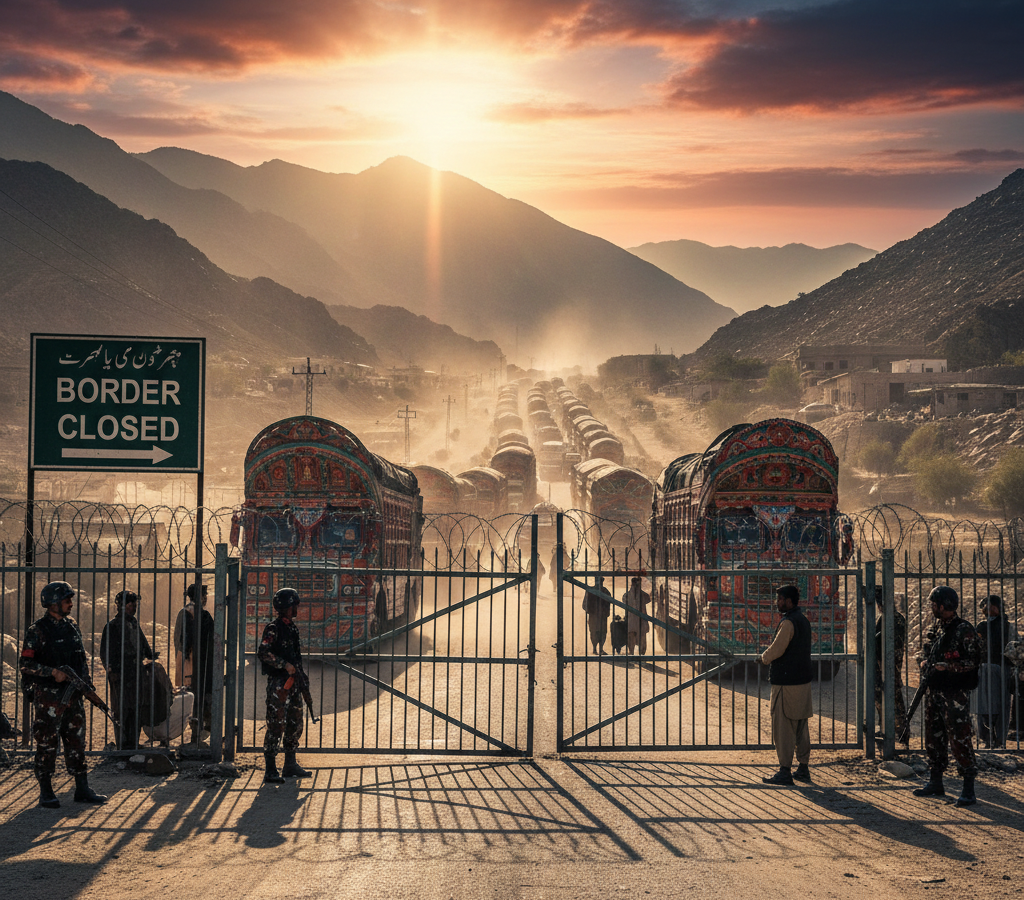
In October 2025, trade between Pakistan and Afghanistan was suspended completely, including border crossings, especially the Torkham border crossing and the Chaman border crossing. After more than 50 days, no material progress in the restoration of the border crossing developed, which causes serious problems for both traders and ordinary people on both sides of the border. Borders were closed for all kinds of commercial activities and transit passage, whereby a large number of freight trucks, goods consignments, and transit cargo have been stuck, disrupting the flow of imports, exports, and essential goods across the border.

Clashes between security forces of both the countries occurred in October 2025. Pakistani authorities immediately suspended cross-border trade until conditions normalise.
Pakistan’s Official Stance (Security and Economic Reform)
- As per DAWN news, Pakistani authorities have cited the “escalating security situation” as the main reason for the border closures at Torkham and Chaman.
- The decision to stop trade and transit was framed as necessary to prevent smuggling, illegal arms and narcotics trafficking, and to counter cross-border terrorism.
- Official statements indicated that customs clearance operations have been suspended at major border stations (including Torkham, Ghulam Khan, Kharlachi, and Angoor Adda) since October 12, 2025.
- At the time of suspension, authorities had cleared existing import consignments (363 vehicles across multiple crossings), but export consignments and transit trade vehicles remained stuck; more than 495 vehicles (combined at Torkham and Chaman) were reportedly still waiting for clearance.
Afghan Authorities’ and Afghan Traders’ Perspective (Alternatives & Damage Control)
From the Afghan side, there have been reports that trade was disrupted and many exporters and farmers are suffering losses due to the border closures. As per a recent report, the closure of border crossings, including Torkham, Spin Boldak, and Chaman, has severely impacted exports, especially fruits and vegetables, for Afghan traders.
According to traders contacted by media, hundreds of containers carrying perishable produce remained stuck, and many consignments have begun to spoil due to delays.
Afghan business owners and transporters said that the disruption is causing serious economic pain. Both for exporters and for their clients in foreign markets waiting for Afghan produce.
Business and Economic Experts (Impact on Both Sides)
Trade body leaders and economic analysts warn that the trade suspension could have adverse consequences upon both sides. According to recent coverage, the prolonged blockade has triggered “significant financial losses for traders, transporters, bonded carriers and clearing agents”.
Transporters and customs clearing agents report that they are absorbing mounting port charges and shipping line detention fees, often between US$150 to 200 per container per day for consignments stuck due to the border closure.
For many border regions, families and small traders who rely on this cross-border commerce, livelihoods are under threat. The stoppage affects not just large exporters but also informal sector workers, truck drivers, labourers and market vendors dependent on the flow of goods.
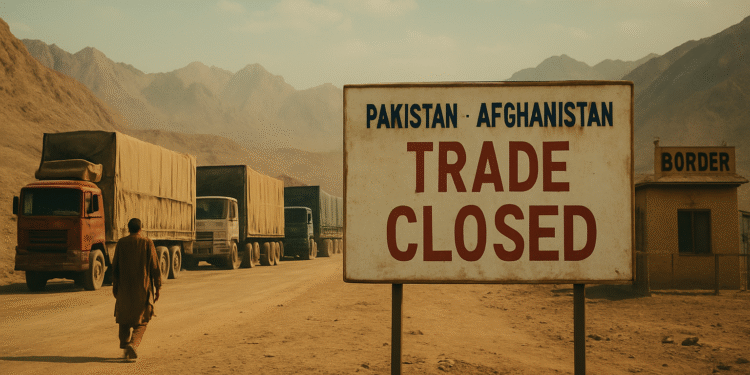
As per the report of ‘The Nation’ newspaper, due to the closure of borders, the loss reached 200 million dollars during just the first 24 days. Further, in the wake of closed borders, Pakistan’s trade with Central Asian countries is cut off, causing a loss of millions of dollars each day. Since Afghanistan usually imports more than 150 million dollars’ worth of goods from Pakistan each month and similarly exports 60 million dollars to the country. The border closure has also affected 20,000 to 25,000 workers.
Immediate Effects: What Has Changed on the Ground
Supply Disruptions, Spoilage, and Price Hikes
With the border closure, perishable goods like fruits and vegetables, which used to cross within days are now stuck for indefinite periods. This has led to spoilage in many cases, causing losses for farmers and traders.
Consumers on both sides have begun feeling the pinch; local markets in Pakistan and Afghanistan are witnessing shortages and rising prices of goods and medicines.
Stranded Cargo, Backlog and Financial Loss
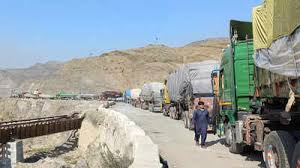
Hundreds of cargo vehicles remain parked, waiting for clearance or return permissions. At the Chaman and Torkham crossings alone, hundreds of transit trade vehicles are reportedly stuck.
Traders and logistics companies are incurring heavy costs due to demurrage, storage, and detention costs, which are rising daily and being passed along the supply chain.
Many small businesses, particularly transporters, customs clearing agents, and freight handlers, are under severe stress. Their cash flows have stopped, and future business remains uncertain.
Human Cost: Livelihoods and Border Communities Under Pressure
Border communities, many of which rely on cross-border trade for wages and livelihoods, are also severely suffering. The atmosphere raised fears of unemployment and economic instability in areas that depend on the movement of goods, particularly for a number of people who depend on it.
For Afghan farmers and exporters, especially those dealing in perishable produce, the closure threatens their income and their ability to supply markets abroad.
Underlying Issues: Security, Smuggling & Regional Stability
According to Pakistani authorities, this trade halt is not simply a reaction to a single event; rather, it is a part of a broader strategy to reform border trade systems, control smuggling of narcotics and arms, and mitigate terrorist infiltration.
Security concerns along the Pak-Afghan border, including recent clashes, militant activity, and threats of cross-border terrorism, have heightened the urgency for taking such measures.
From Islamabad’s perspective, opening trade without ensuring border security and better monitoring systems would risk national security and public safety.
On the other hand, critics warn that prolonged closure risks turning formal trade into informal smuggling once again as traders and transporters look for workaround routes, undermining the very goals the government aims to achieve.
What It Means for the Future: Challenges and Possibilities
Key Challenges
· Economic hardship for border region communities: Continued closure threatens livelihoods of thousands of people dependent on cross-border commerce.
· Supply chain disruptions and inflation: Persistent shortages and price hikes — especially for perishable and essential goods — may intensify if closure extends further.
· Erosion of bilateral trade ties: Repeated suspensions can weaken longstanding economic relations between Pakistan and Afghanistan, reducing trust and reliability.
· Risk of informal trade and smuggling: If legitimate trade channels remain closed, unofficial and unregulated routes may flourish, undermining official oversight.
Possible Roads Ahead
· Diplomatic engagement & security agreements: A durable resolution likely requires joint efforts to address security concerns, dismantle smuggling networks, and rebuild confidence at border crossings.
· Improved infrastructure & border management systems: Investing in better customs clearance systems, tracking, sealing, and monitoring may help ensure safe trade while addressing security.
· Diversification of trade routes: Afghanistan might increasingly rely on alternative corridors, though establishing these will require time, investment, and regional cooperation.
Present status
At present, even in November 2025, borders are still closed and trade has been suspended, as a result of which thousands of trucks still remain stranded at the border with no clear indication when trade might resume. Different phases of discussion between both countries ended with no substantial outcome.
Conclusion
The trade halt between Pakistan and Afghanistan, marked by the closure of major border crossings such as Torkham and Chaman, reflects a tense moment in bilateral relations, even though they are both Muslim countries and have historical relations, where security concerns have forced economic ties to take a back seat. While Islamabad stresses national security and the need to curb smuggling and militancy. The economic and human costs of prolonged closure are already evident, cutting off cargo, causing losses for traders, surging prices, and threatening livelihoods.
After more than one month of closed borders, immediate restoration of trade is required, ensuring border security, rebuilding trust, and reactivating trade routes in a regulated, transparent manner. The restoration of border crossings is desperately required on humanitarian grounds. Without it, frequent suspensions may ensue dire consequences for both sides, but the welfare of border communities and economies of both countries depends on cross-border trade.